
The Transcending Number Seven
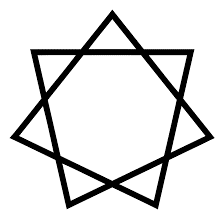
The use and meaningfulness of the number seven, and the seven point star known as a heptagram (also called a septagram), throughout science, religions, mythology, superstitions, and philosophies has transcended geography, culture, language and time.
Here is what search results will tell you at a top level based on either the number seven or the heptagram. I took lots of searches with scattered results so the following is not in any particular order or priority.
- The heptagram was used in Christianity to symbolize the seven days of creation and became a traditional symbol for warding off evil…..see police badges like the CHP.
- There are also the seven deadly sins, the seven layers of purgatory, and the seven sacraments in the Catholic church.
- The heptagram is a symbol of perfection (or God) in many Christian religions.
- Genesis 1:1 was composed of seven Hebrew words containing a total of 28 letters. Throughout the Bible the number seven appears repeatedly as a symbol of divine perfection – the 7 days of creation
- In Christian tradition, the seven heavenly virtues combine the four cardinal virtues of prudence, justice, temperance, and fortitude with the three theological virtues of faith, hope, and charity.
- Psalm 7, the seventh psalm in the Book of Psalms, is traditionally attributed to King David, and is a regular part of many Christian and Jewish liturgies. The psalm’s message is that the righteous will ultimately prevail against the wicked, even though they may seem weak
- The book of Revelation is filled with the number seven.
- The letters to the seven churches in the Book of Revelation were written by John the Apostle, who was exiled on the island of Patmos, and they were dictated to him by Jesus Christ, who gave him the messages and commanded him to write them down for the churches in Asia Minor: Ephesus, Smyrna, Pergamum, Thyatira, Sardis, Philadelphia, and Laodicea.
- The 7seals in the Book of Revelation are a series of events that will occur on Earth from the time of Christ until his second coming. Each seal represents a specific time period and event.
- First seal: Suggests military force and government action
- Second seal: A fiery red horse ridden by someone who takes peace from Earth, causing people to kill each other
- Third seal: A black horse ridden by someone who causes famines and food shortages
- Fourth seal: A pale horse ridden by Death, who is given power to kill with sword, famine, pestilence, and wild beasts
- Fifth seal: Souls crying out from under the altar
- Sixth seal: Events connected with the second coming of Christ
- Seventh seal: Silence in heaven, and the distribution of trumpets to seven angels
- The tribulation lasts seven years and has 3 sets of seven judgments: the seals, the trumpets, and the bowls or the vials.
- From Rev. 12–16, there are seven personages: The Woman, The Dragon, The Child, The Archangel, The Beast out of the Sea, The Beast out of the Earth and The Lamb.
- There are seven messages in Rev. 14-16: The New Song, The Everlasting Gospel, The Fall of Babylon, The Warning of Eternal Doom, The Blessing of the Faithful, The Harvest of Destruction, The Announcement of the Seven Vials.
- There are also the seven spirits before the throne (1:4), which in chapter 5:6 are also represented as the seven horns and seven eyes of the slain Lamb, and those seven spirits are sent forth into all the Earth.
- There are also, in chapter 1 the seven stars and the seven golden candlesticks, which represents the seven angels over the seven churches (1:20).
- When the two witnesses die and come back to life and are caught up to Heaven in a cloud, there’s a great earthquake afterward that kills seven thousand men (11:13).
- There are the seven thunders of Rev. 10. The great red dragon will have seven heads, ten horns, and seven crowns upon his heads (12:3). The Beast out of the Sea also has seven heads (13:1). The woman sitting upon the scarlet-colored beast, full of names of blasphemy, also has seven heads and ten horns (17:3).
- In both Islam and Judaism, there are seven heavens.
- In Islam, the seven heavens, or samāwāt (سماوات), are regions above Earth that are guarded by angels and inhabited by souls
- In the Talmud (Hebrew Bible), it is suggested that the upper part of the universe is made up of seven heavens (Hebrew: shamayim):[15]
- Vilon (וילון), see (Isa 40:22)
- Raki’a (רקיע), see (Gen 1:17)
- Shehaqim (שחקים), see (Ps 78:23, Midr. Teh. to Ps. xix. 7)
- Zebul (זבול), see (Isa 63:15, 1 Kings 8:13)
- Ma’on (מעון), see (Deut 26:15, Ps 42:9)
- Machon (מכון), see (1 Kings 8:39, Deut 28:12)
- Araboth (ערבות), The seventh Heaven where ophanim, the seraphim, and the hayyoth and the Throne of God are located.[16]
- The number seven is Judaism’s most sacred number and signifies fullness or completeness
- The Seal of the Seven Archangels is a powerful symbol and talisman used in esoteric and spiritual traditions to invoke the protection, guidance, and blessings of the seven archangels, who are believed to be divine intermediaries. Often incorporating a seven-pointed star (heptagram) or hexagram with the names of these powerful spiritual beings, the seal is used to ward off negative energies, promote happiness, and provide spiritual protection in various traditions, including Christianity, Judaism, Islam, and New Age spirituality.
- The “Seal of the Seven Archangels” doesn’t have a single, clear origin, but rather developed from various religious and mystical traditions, including the Book of Enoch (which listed several archangels), Babylonian mythology, and astrological beliefs associating angels with the seven classical planets. This symbol, often a seven-pointed star (heptagram), became a widely recognized talisman in ceremonial magic and esoteric traditions for protection and to invoke spiritual guidance.
- The Seven Archangels associated with the virtues, although not explicitly named in the Bible, are widely recognized in tradition, with variations in specific names and virtues, but generally include:
- Michael (Justice,
- Gabriel (Faith)
- Raphael (Temperance)
- Uriel (Wisdom)
- Jophiel (Hope)
- Chamuel/Camael (Love/Fortitude)
- Zadkiel (Righteousness/Loyalty).
- These virtues are often presented as divine responses to the Seven Deadly Sins, aiming to guide humanity toward goodness.
- The seven deadly sins according to the Catholic Church are pride, greed, wrath, envy, lust, gluttony, and sloth.
- Allah created seven heavens, seven earths and seven days, and man’s creation is completed in seven stages
- In Islam, the heptagram is used to represent the first seven verses in the Quran
- The first seven verses of the Quran are from the first chapter, Surah Al-Fatihah, which is also known as the “Opening” or “Fatiha”:
- Verse 1: “In the name of God (Allah), the Compassionate and Merciful”
- Verse 2: “Praise be to God, Lord of the worlds”
- Verse 3: “the Compassionate and Merciful”
- Verse 4: “Master of the Day of Judgement”
- Verse 5: “Thee we worship and from Thee we seek help”
- Verse 6: “Guide us upon the straight path”
- Verse 7: “the path of those whom Thou hast blessed, not of those who incur wrath, nor of those who are astray”
- The first seven verses of the Quran are from the first chapter, Surah Al-Fatihah, which is also known as the “Opening” or “Fatiha”:
- The heptagram is known among neopagans as the Elven Star or Fairy Star. It is treated as a sacred symbol in various modern pagan and witchcraft traditions.
- In alchemy, a seven-sided star can refer to the seven planets which were known to ancient alchemists.
- George Gurdjieff, an eighteenth century philosopher and mystic, speaks very explicitly about seven days, seven colors, seven tones, seven vibrations, seven branches of knowledge.
- The Law of Seven is an ancient spiritual law that states that everything in the universe vibrates at its own unique frequency
- In astrology, the number 7 is associated with the planet Neptune, which is linked to dreams, feelings, and things that are difficult to see
- In numerology, the number 7 is often associated with knowledge, mystery, and intuition
- People who are associated with the number 7 are thought to be wise, insightful, and intellectual, and may also be introspective and truthful. They may also be focused, confident, and assertive, and may value fairness and truth.
- The Pythagoreans invested particular numbers with unique spiritual properties. The number seven was considered to be particularly interesting because it consisted of the union of the physical (number 4) with the spiritual (number 3). In Pythagorean numerology the number 7 means spirituality.
- After Birth, the 7th hour decides whether the child will live, in 7 days the cord falls off, in twice 7 days the eyes follow a light, thrice 7 days turns the head, 7 months gets teeth, twice 7 months sits firmly, thrice 7 months begins to talk, after 4 times 7 months walks strongly.
- After 7 years, teeth of a second set appear.
- After 14 years is the arrival of generative power.
- After 21 years, the hair of Manhood is completed.
- After 28 we cease to grow, at 35 is greatest strength,
- At 49 is the greatest discretion, and 70 is the natural end of Life.
- The body has seven obvious parts, the head, chest, abdomen, two legs and two arms.
- There are seven internal organs, stomach, liver, heart, lungs, spleen and two kidneys.
- 7 seas
- 7 continents
- 7 wonders of the world
- 7 colors of the rainbow
- 7 musical octaves
- 7even days in a week
- 7 chakras
- Root (Muladhara): Located at the base of the spine, this chakra is said to provide stability, grounding, and a sense of security
- Sacral (Svadhishthana): This chakra is said to enhance creativity, passion, and emotional well-being
- Solar Plexus (Manipura): This chakra is said to boost confidence, personal power, and self-esteem
- Heart (Anahata): Located in the middle of the chest, this chakra is said to promote love, compassion, and emotional healing
- Throat (Vishuddha): This is one of the higher three chakras
- Third Eye (Ajna): This is one of the higher three chakras
- Crown (Sahasrara): This chakra is said to represent our connection to the divine and universal consciousness
- In many mythologies, the number seven appears, including:
- The seven lives of cats in Iran and other cultures
- The seven gateways Inanna traversed in the underworld
- The seven sister goddesses in Baltic mythology
- The seven prominent monsters in Guaraní mythology
- The seven steps taken by the Buddha after his birth
- The number seven appears in many folk tales, including:
- The seven years Thomas the Rhymer spent in the faerie kingdom
- The idea that breaking a mirror leads to seven years of bad luck
- 7 Sisters
- Seven is the number of stars in the Pleiades, known as the Seven Sisters, each of which represents for the Hopi one of the universes designated for the people and defines the length of the seven songs of Creation, and all together “the way of man on his Road of Life through seven consecutive worlds
- Seven Senses: smell, taste, sight, touch, hearing and 6th, Mental perception, with 7th, spiritual understanding
- The neutral pH balance is seven.
- Number of spots most commonly found on ladybugs is seven.
- 7 stages of life with associated planets; thus:
- Infancy – Moon, Luna;
- Childhood – Mercury, Knowledge;
- Youth – Venus, Love;
- Maturity – Mars;
- Manhood – Sol (Sun), Full Strength;
- Judgment – Jupiter;
- Old Age – Saturn.
- When we pass white light through a prism it splits into 7 distinct colors. Thus white light or visible light contains within it 7 colors. This phenomenon also explains why rainbows display seven colors.
- In Hinduism, the Sun God, Surya, travels across the sky in a chariot pulled by seven horses. These seven horses symbolize the seven colors. Therefore, the seven-pointed star also represents the Sun and the infinite solar energy that is responsible for all life on Earth.
- The seven Pheras, also known as the Saptapadi, is a significant Hindu wedding ritual where the bride and groom walk around a sacred fire seven times, reciting vows at each step. During a Hindu wedding ceremony, the bride and groom walk around a holy fire seven times, symbolizing their union and commitment across seven lifetimes
- Buddhism also teaches the seven factors of enlightenment, or satta sambojjhaṅgā, which are:
- Mindfulness (sati)
- Investigation of the dhamma (dhammavicaya)
- Energy (viriya)
- Happiness (piti)
- Calm (passaddhi)
- Concentration (samadhi)
- Equanimity (upekkha)
- Also in Buddhism, seven represents the cycle of life and death, and appears in many aspects of Buddhist mythology and belief:
- The Buddha’s birth: After being born, the Buddha took seven steps and declared himself the World-Honored One.
- Maya’s death: Maya died seven days after the Buddha’s birth.
- The soul’s crossing over: In folk Buddhist belief, the soul crosses over after seven or 49 days.
- The seven lives of the stream enterer: The seven lives of the stream enterer represent crossing over the cycle of life and death.
- The lunar cycles: The number seven relates to the lunar cycles, which represent a sense of a cycle, return, death, and rebirth.
- The number of visible planets: The number seven relates to the number of visible planets, which also represent a sense of a cycle, return, death, and rebirth
- In Confucianism, 7 represents harmony between yin, yang, earth, fire, water, wood, and metal. 7 days of the week, 7 colors of the rainbow
- Japanese Buddhists celebrate a baby’s seventh day and mourn the seventh day after a person dies when the soul is said to cross over.
- The number seven is the smallest number that’s a happy number, meaning it eventually ends in a sequence of ones when you repeatedly square its digits and add the answers.
- Big dipper has seven main stars
- To the Hindu, the Big Dipper is represented by the seven wise men or sages
- Before the Civil War, the Big Dipper was a guide to freedom for slaves traveling on the Underground Railroad. The Big Dipper points to the North Star. Runaway slaves who found the Big Dipper used it to lead them North to freedom.
- In Arabian lore, the Big Dipper is associated with funerals. The bowl represents a coffin and the three stars in the handle are mourners following behind
- In Polynesia, the seven-pointed star is used often in imagery, basket making, tattoos, and is considered to be a symbol of Kanaloa, the first Polynesian navigator
- In geometry, The number 7 represents purity, wisdom, unconditional love, and Spirit. It is also associated with the rhythm of life, i.e. it embodies the idea of a complete cycle of manifestation due to its qualities of perfect unity (3 – trinity) and materiality (4 – quaternary). It expresses the idea of the rule of spirit over form and symbolizes the connection between the macrocosm and the microcosm.
- In Egyptian mythology, the number seven symbolizes perfection, effectiveness, and completeness
- Also in Egyptian mythology, The first rite of passage for Egyptian babies was a ceremony called the Sebou, which was held on the seventh day of the baby’s life and the Seven Hathors were a group of goddesses associated with fate and fortune telling. They were worshipped in seven cities, and their priests could read the fortunes of newborns and explain people’s dreams.
- The Seven Hathors of the Celestial Herd (aka The Pleiades).
- The Seven Hathors were a group of sacred forms of the Egyptian goddess Hathor that determined an infant’s fate at birth. They were sometimes depicted as seven cows, accompanied by the Bull of the West, a minor sky and afterlife deity. The names of the Seven Hathors were:
- “Lady of the Universe”
- “Sky-storm”
- “The hidden one, presiding over her place”
- “You, from Khemmis”
- “Red-hair”
- “Bright Red”
- “Your Name prevails over the West”
- In Chinese culture, this is recognized as Liù Jio Xng, and it signifies good fortune and fortunate energy.
- In Native American customs, this is linked to the balance of the realms and the seven directions.
- In Hermeticism, it symbolizes the coexistence of the heavenly and physical worlds.
- Seven churches in Book of Revelations
- Some historicists typically interpret the seven churches as representing seven different periods in the history of the Western Church from the time of Paul until the return of Jesus Christ.
- After His resurrection, Jesus Christ commissioned the apostle John to write letters to seven churches in Asia Minor about their spiritual condition.
- Rome: The letter to the Romans, a foundational text on justification by faith.
- Corinth: 1 & 2 Corinthians, addressing divisions, immorality, and spiritual gifts.
- Galatia: Galatians, defending salvation by grace through faith, not works.
- Ephesus: Ephesians, focusing on the unity of believers in Christ.
- Philippi: Philippians, an epistle of joy and encouragement.
- Colossae: Colossians, warning against false teachings and exalting Christ’s supremacy.
- Thessalonica: 1 & 2 Thessalonians, dealing with Christian ethics and the Second Coming.
- After His resurrection, Jesus Christ commissioned the apostle John to write letters to seven churches in Asia Minor about their spiritual condition.
- Some historicists typically interpret the seven churches as representing seven different periods in the history of the Western Church from the time of Paul until the return of Jesus Christ.
- In Revelation 1:20, the Son of Man is seen walking among seven lampstands and holding seven stars in his right hand. The seven stars represent the angels of the seven churches, and the seven lampstands represent the seven churches.
- In Revelation 16, the seventh angel announces that the time of the Second Coming has come.
- In alchemy, the seven-pointed star represents the seven planets known to early alchemists and the seven alchemical substances: fire, water, air, earth, sulfur, salt, and mercury
- The seven-pointed star is a significant symbol in Cherokee culture. It represents the seven clans of the Cherokee people: Bird, Long Hair, Paint, Deer, Wolf, Blue, and Wild Potato. The star also represents the seven characters of Sequoyah’s syllabary, which means “Cherokee Nation”.
- The number seven is also significant in:
- Mesopotamian culture
- The cult of Mithra
- The Indian Vedas
- Chinese culture, where it’s considered a good number for relationships
- Hinduism, where it symbolizes cycles and completion
- The “seven Anunnaki gods” usually refer to the most powerful deities in Sumerian myth, often called the “seven who decree,” including An (sky), Enlil (air), Enki (water/wisdom), Ninhursag (earth), Nanna (moon), Utu (sun), and Inanna (love/war), though lists varied and the Anunnaki were a larger group of powerful gods descended from Anu, shaping Mesopotamian civilization and its relationship with humanity. The Core Seven (Most Common Identification):
- An (Anu): The supreme sky god, father of many deities.
- Enlil: God of wind, air, and storms, key figure in cosmic order.
- Enki (Ea): God of water, wisdom, creation, and humanity’s friend.
- Ninhursag (Ki): Earth and mother goddess, associated with fertility.
- Nanna (Sin): Moon god, associated with time and wisdom.
- Utu (Shamash): Sun god, god of justice and truth.
- Inanna (Ishtar): Goddess of love, beauty, war, and political power.
Additional links and documentation can be found here: https://en.wikipedia.org/wiki/7 and you will go down several rabbit holes googling the use of the number seven and reading the AI generated answers.
What I found most interesting is that there is no use of the number seven in Animism. Animism is a way of viewing the world where all things, including animals, plants, rocks, and rivers, have a spiritual essence. Animism is not a set religion, but rather a way of engaging with the world. Simply put, animism is a worldview which states that all beings, humans, animals, plants, lands, and waters, live within an interconnected web of spirituality. Animism applies personhood and agency to non-human beings.
Also, there is no number seven in Aboriginal Spirituality. Aboriginal Spirituality is different than Animism. Aboriginals believe that many animals and plants are interchangeable with human life through re-incarnation of the spirit or soul. The Golden Rule in Aboriginal Spirituality states that “we are as much alive as we keep the earth alive.” By treating the earth with the same respect we expect for ourselves, we may foster our connection with the environment and be more motivated to ensure its’ survival. Aboriginals believe that the entire world was made by their Ancestors way back in the very beginning of time, the Dreamtime. The Ancestors made everything. The Ancestors made particular sites to show the Indigenous people which places were to be sacred. Only the number four is meaningful to Aboriginal belief. The Dreamtime has four parts: The beginning of everything; the life and power of the ancestors; the way of life and death; and power in life. Dreamtime was all four of these things at the same time because it is more powerful than time and space.
Oh, and my wife was the seventh child.
There is a lot more to explore about aboriginal spirituality but that is for another post.
Making Character Greater Again

What is Your Character?
Character is defined as the mental and moral qualities distinctive to an individual. It is who you are and it determines how you relate to others. It is your personal development, it impacts your relationships and can help determine the outcome of your goals. It can influence the decisions you make, the way you learn, the way you manage, and how others perceive you.
Your character is what people see in front of them, how you act, and who they are listening to when you speak. Your character is NOT something defined by personality trait assessments, colorful strengthsfinder graphics, or word association surveys that tell you how you are supposedly wired for limits.
How Does Your Character Form?
Although the experts tell us our formative years in childhood are defined as 0-8 years of age, I’d argue a theory that your characters’ formative years starts at age 10-12 as you meet memorable and influential people. It continues to evolve with 50% of your distinctiveness forming at 12-18 years of age, an additional 25% coming through age 24 and the last 25% should be fluid throughout the rest of your journey.
What Are COI’s?
These memorable and influential people are considered your “Centers of Influence” or COI’s. This concept was originally given to us by Ellen White and is used in a broader definition to include individuals in your own circles or concentric circles of friends and colleagues. COI’s can be life long influences throughout your journey, be a short part of the journey that fills a purpose in the moment, or supersedes a previous person in a particular seat on your current bus.
COI’s could be bosses, coaches, co-workers, older kids you knew, teachers, or family members. You remember them for something they said, something they did, something they wrote, someway they behaved, something they were good at, someone you experienced something epic with, or an action they took. Maybe they were the only ones to be honest and truthful with you or helped you at your worst. They could be a character in a movie that represents what you want to be and they can be historical or religious figures, artists, or even philosophers. I can argue the COI’s can also be experiences or memories from events.
Who Are Your COI’s?
Let’s test this theory of character evolution. Make a quick list of the people, events, or idols that positively impacted you and who you still think of today in your thoughts, words, and deeds from before you were 24 years old.
Now who or what have you met, idolized, or experienced in the last 10 years that could be an upgrade from the original seat holders? I had 30 on my quick list and as I looked at my current contacts I only swapped out 10. I won’t say who or what but the memorable individuals and things that I was surrounded with in my younger years set the bar pretty high and if you have had the same, you realize that having the right people around or experiences has been a benefit to who you are. I have also found the as we have grown as a family, the events and activities that
Is Character Permanent?
Now what happens to your character as you get older and set in your ways? The quote “You are the average of the five people you spend the most time with” is often attributed to motivational speaker Jim Rohn. If true, then I’ll ask if those five individuals are lifting you up, keeping you at a mediocre level, or dragging you down from your greater potential? What would your mom, dad, wife, husband or any significant other that unconditionally loves you say?
This quote was the basis for our “Turd Test” when our son was growing up. “What are you going to smell like if all the kids you hang around with are turds? Pretty self explanatory and combined with the Golden Rule and The Mom Test, I think we gave the kid a pretty decent decision support system for his early formative years. Sure you can argue who defines “turdness” and sets the floor of qualifications, but as a society I think conventional wisdom gets us 95% there.
Why five? You can read about the law of 3 and law of 7 but why stop there as well. Why not 10? Why not 20? 50? The point I am driving towards is why limit yourself to the amount of people that can raise your average and then what are you doing to surround yourself with even more? One of the rules I follow and preach is to always be learning, meeting new people, and helping others and great things will develop. It does not matter which order, it matters that you take action and keep taking action on the three activities.
Should COI’s Be Permanent?
Covey’s 7th habit is to sharpen the saw and one way is to keep surrounding yourself with great people that can challenge you and grow you further. Joe Sweeny’s success model proved networking is a contact sport and emphasizes the need to know the right people to get things done by being a connector. William Morris (actually created wallpaper) said to keep nothing in your houses that you do not know to be useful or believe to be beautiful which supports the necessity to keep turds out of your life.
ABC is a well known selling call for action to “Always Be Closing”. I am suggesting and challenging you to repurpose ABC to “Always Be Churning” meaning always be meeting new people, remembering the parts that influence you, and then keep meeting additional people. Whether you are in sales or not, in leadership or not, or just on a quest to be the best human you can be. There is strength in numbers and I believe the room is always smarter than the individual so make sure your room is full of quality and experienced people that can lift you up.
Meeting and surrounding yourself with the right people can be a force multiplier to your character and also help you achieve bigger and better goals as you leverage what you learn and include others in working with you towards shared visions and goals.
If your COI’s keep improving, your character has no choice but to follow.
Whose Character Are You Making Greater?
You should flip this process as well and look at where you are in the whole concentric COI circles you play in. Whose 5,10, or 20 are you grouped in with? Who is looking at you for advice and experience? It may say a lot about how people see you and give you some insights and ideas about changing your beliefs, values, actions and character. Even Scrooge and the Grinch evolved and I would remind you of the turd test for who you are surrounded by at the next networking event or roundtable that you are asked to join.
Now an additional challenge to parents: Who are you surrounding your kids with to build their character? In addition, who are you surrounded with at their events and activities that can support that?
Stay turd free my friends!!!!!
I hope these thoughts and philosophies help you increase your opportunities.

 Peter C. Rathmann