
Why Hire #Neurodiveristy in #Manufacturing? Because You Can’t Fail.

We are all battling a lack of people applying for open positions in our companies and combine that with the fact there is a strata of the workforce that is working harder to stay home and get out of work than to add value to the world.
What if you can find productive employees and guarantee your next hire would:
- Always be on time.
- Want to learn more daily.
- Care about the work they do.
- Create efficiencies that you did not consider.
- Set an example for others.
Where would you spend your time? Now, what if I told you there are 170,000+ of these capable employees available to start tomorrow just in Wisconsin alone?
What if you learned that there are no state programs to qualify for, apply to, or wait for a response in 90 days. There is no three page job description to write and that other Manufacturers in the private sector already have success that you can use as a model? All you have to do is give a shit to make this work.
Need a business case for the doubters? What if you learned that 11.9% of the population is considered to have a disability, and hence be neurodiverse, but only 19.1% of them are employed? How about the fact that employers that hire people with disabilities have on average 28% higher revenue, double the net income, and 30% higher profit margins than their peer group? Another fun fact published by the government, is that GDP in the USA could be boosted up to $25 billion dollars if just 1% additional people with disabilities joined the labor force.
My daughter Emma Rathmann and I were honored to give the opening presentation at the Disability:IN Wisconsin event on Hiring Neurodiverse Talent to Grow Manufacturing last week hosted by Engauge Workforce Solutions. Over 100 talent seekers and employers attended for the purpose of learning more about hiring the most under considered and capable workforce this region, state, and world has to offer.
Also presenting at the event were Goldhmong Vang,Katie Malnight Meisinger Corryn Manderfield, and the Down Syndrome Association of Wisconsin. The audience was filled with , , leaders, other Service Providers, and even parents of sons and daughters looking for companies that “get it” and can help provide a caring environment and future for their kids.
The following is a recap from our presentation about the commonalities of all the success stories just from our close circle of neurodiverse friends that are gainfully employed and adding value to the efforts in the private sector. Some people thought this presentation was about the formula we created for success. In reality, this is a documentary of what we see working with the individuals we know besides our own experiences.
Let’s first talk about the shared characteristics of your future employees:
- They have defined schedules and availability;
- They have favorite interests, foods, and communication styles;
- They have a linear and VERY literal thought process;
- They see the world as flat when it comes to organizational charts and hierarchy, which translates to treating the groundskeeper on the same level as the CEO (BTW, This should be your leadership style if it isn’t already).
Tell me how any of this is unmanageable?
Let’s talk secondly about the shared characteristics of the accommodations that other companies are making for these employees:
- They offer flexible and part time schedules;
- They have a horizontal structure on mission and surround the employee with others that are available to help mentor and answer questions that arise;
- They help the employee understand what their role is and why there are certain requirements for clothing and safety equipment;
- They offer stacked training and build a playbook and handbook specifically for the role the employee is in, as well as have them job shadow until they are comfortable performing on their own;
- They give clear directions and instructions with tangible metrics for the employee to gamify their duties and measure their own progress.
Tell me how any of this is impossible for you to offer?
No replication of your favorite recipe is successful without the right ingredients so you need to understand all of the shared characteristics and parts of the employment model that the current success stories share.
- The employee does have the desire to work, the capability to do the work, a consistent and predictable schedule, and the ability to advocate for themselves;
- The opportunity for the employee is aligned on their skill sets, are supported by other employees with interactions from multiple levels within the company;
- The employees’ family was involved and is in communication with the stakeholders within the company and has provided insights for the management, helps with pregame and postgame daily routine before and after work, and the family has learned to trust that the company is looking out for the employee on all levels.This will be the hardest part for the employer to prove themselves as a safe and growth environment for their child;
- The position is supported through a staffing agency, has access to additional training and education resources through non-profits, and has transportation needs filled by the family or a service.
Just as the right ingredients are necessary, so is how those ingredients work together on a daily, weekly and monthly basis. I call it “The Committed Ecosystem” as pictured in the opening of this article. No matter how large the organization is, if you find someone that can be on time, cares about the work they do, and wants to learn, you are going to make room for them.
- There absolutely needs to be selfless vision and leadership in the organization to want to hire neurodiverse employees. A company should be a people system first and that will drive the business systems.
- The middle management needs to be informed, educated, and empowered to work with and help grow their team members. This is the biggest point of failure for many organizations that say they are diverse and inclusive on their mission statements but then do not provide the middle management the tools they need which leaves the employee in a sink or swim situation that frustrates all parties involved and is ultimately a failure.
- The supportive team members are the most important ingredient. You need to surround the employee with the right people that are willing to teach others, can be selfless themselves, and measure their own success through the growth of others. Pay these people well!
An interesting tangent to this, while presenting this material to a group of parents the previous week, a fellow Dad asked what I would do as the CEO when their child comes home and says that someone called them a certain derogatory name and bullied their child’s situation. My answer as a Dad was that we have been in that situation and what I wanted to do was considered a hate crime in most developed nations. My answer a week later as a CEO that employs now four neurodiverse individuals, is that if I have not built an organization of people aligned on a common goal that want to see each other do well as much as be experts in their own space, I have failed and don’t deserve to employ their son or daughter.
- The Family and the 4th Party Resources (like transportation, the staffing company, the trainers and outside partners) are very much aligned and in communication about the employee. This is essentially the “it takes a village” aspect of your journey and everyone having access to each other to address any schedule changes, additional training opportunities, and questions that may develop by anyone in this journey to grow the opportunity for the individual is key. One of the presenters at the seminar actually stated that it “takes a city sometimes”. I don’t disagree and each situation is going to be unique.
The capstone to this article is how to build your playbook for success in hiring a neurodiverse employee. I wish I had a patented process that I could guarantee would work for you with a money back guarantee, but the real chance for success is for you to just get started using the following process parts and make adjustments as needed.
- First, replicate success. There are other companies out there that are doing this successfully and their partners in success are just waiting to help others. Use your network, cross pollinate best practices and make introductions. I guarantee if you are reading this, you know someone that is neurodiverse and have the people in your network that can help. There is a Chinese Proverb that states the best time to plant an oak tree was 30 years ago, the next best time is now.
- Second, if you are going to be the one driving the mission, then build your village (or city). Find a staffing agency that can support the hiring model if you are tied to certain hiring policies and processes that are found in union based shops or complex companies. Call the position contract based or seasonal and you have some flexibility.
- Thirdly, when you find an individual that you want to hire, define what success looks like, who the stakeholders are and create roles. Make sure your new employee understands where their role fits into the big picture of the operations, what the goals are, and how they can measure their success.
- Fourthly, you need to stay agile and responsive on this journey with the employee. There will be some unknowns like hiring anyone else, there will be a few schedule changes and there will be a few situations that the employee may need help navigating.
- Finally, be visible. Praise efforts and achievements, check in often with your management and frontline team members, leave the door open for anyone to ask questions, be creative with analogies and examples to teach everyone involved and have patience. By the way, this entire journey may be a bottom up solution so be receptive.
You can not fail at this because any action you take to help employ the neurodiverse or support that action is more than you did yesterday and more than the market had. Just get started. You’ll figure out the second step once you do.
At the 2023 Berkshire Hathaway Shareholders Meeting, Warren Buffett said this country is missing a “Unity of Purpose” on several items in reference to how the country pulled together during WWII and for the Space Race to the Moon. Everyone in the room last week shared a unity of purpose of integrating some of the most capable individuals in the world into their manufacturing efforts and I look forward to more success stories being posted.
Emma and I are available to anyone that would like assistance in any or all of the parts of this article. By the way, my daughter Emma was diagnosed with Aspergers at age 12 and is now employed at HUSCO International surrounded by fantastic humans in a win-win model for production and making a difference in growing her. It has been a journey together as a Family and will continue to be and we are eternally grateful for the team there.
Accommodating Uniqueness
Four Legged Stool
Committed Organization
Build Your Plan
Disconnect between a vision and execution
Takes a village
It is important for all of us to foster an environment that is conducive to neurodiversity, and to recognize and emphasize each person’s individual strengths and talents while also providing support for their differences and needs.
How can employers make their workplaces more neurodiversity-friendly?
Offer small adjustments to an employee’s workspace to accommodate any sensory needs, such as
Sound sensitivity: Offer a quiet break space, communicate expected loud noises (like fire drills), offer noise-cancelling headphones.
Tactile: Allow modifications to the usual work uniform.
Movements: Allow the use of fidget toys, allow extra movement breaks, offer flexible seating.
Use a clear communication style:
Avoid sarcasm, euphemisms, and implied messages.
Provide concise verbal and written instructions for tasks, and break tasks down into small steps.
Inform people about workplace/social etiquette, and don’t assume someone is deliberately breaking the rules or being rude.
Try to give advance notice if plans are changing, and provide a reason for the change.
Don’t make assumptions — ask a person’s individual preferences, needs, and goals.
Be kind, be patient.
Ecosystem – Ven diagram of employee, company, family, 4th party resources = growth
Forward thinking…..
References
How Covidiocy Strengthened Grit

This is a follow up to the post “Leading Against Existential Threats” from March of ’20. You can revisit it here and you can find the definition of “Covidiocy” here.
Chances are that if you were in a leadership role in ’20 and ’21, you struggled to make sense of the fluid situations we were handed, but if you stayed true to values and pushed through everything, you have evolved into a more resilient and grittier leader.
As I have reconnected with several people that I respect and consider impactful on my business success and evolution as a leader, I asked every one of them the same question; “How has your mindset, priorities, actions, and decision making changed in your business and personal life after the past two years?”
Many companies experienced anywhere from a 20 to 60 percent loss in revenue in 2020 and into 2021, and more than 14 million Americans either temporarily or permanently lost their jobs. Half of society was deemed unessential, people got paid more to stay home, we mastered washing our hands but those of us still on the roads forgot how to use turn signals. With a 99% survival rate, >90% of the fatalities being realized in older people with several co-morbidities, we had to make it about the children and deaths by gun shot wounds and motorcycle accidents counted towards the daily death tolls leaving us with more questions than answers from the health “experts” about real risks. Toilet paper was rationed and we couldn’t get our hair cut or go out for a beer, but weird how no grocery clerk or gas station attendant died of symptoms. We even threw out the global play book that was adopted by the experts in case things like this happened. In fact, now we have a study from the same people that produced the first study we threw out that says we should not have thrown out that previous study and never should have followed the second study. Douglas Adams could not have dreamed this scenario up.
The Covidiocy started in March of ’20 and still continues in some aspects today. All of the sudden we all felt like Robinson Crusoe being thrown into a strange and surprising adventure and it was trial by fire time. As things evolved, there was no pondering WWJD, no ghost written bibliographies from leaders during Spanish Flu or Black Plague to learn from, there were no wiki’s or even historical references for leaders to use, and no precedent for the command and control political decisions that were being handed down daily with false end dates. Opinion became scientific fact and objectivity disappeared. Biased subjective misinformation became gospel and fear was willingly used against individual liberties and free market economics.
Not everyone in my circles fully landed on both feet after two years of staying committed to their roles and responsibilities. There was a lot of burn out and a lot of good people retired early or took simpler roles where they can just take orders and no longer be the one that gives orders. I miss them and I am grateful for a few stronger people than myself that kept me going.
Business leaders spent the last two years getting kicked in the groin daily and weekly by government policies, conflicting health data, lack of consistency in supply chain delivery and responsiveness, chirping crickets when you needed questions answered from your customers that went remote, and trying to write a new play book weekly for business strategy as the world was changing the game. All this while you tried to keep your employees whole and involved with decisions, being empathetic to their family needs and life balance, and helping to translate all of the politics of the situation where objective truth was non-existent or buried. Not to mention that the people that tried to raise flags of concern and had objective data to prove it were cancelled and deemed witches. The Salem Witch Trials may have taken place in the 1690’s but I would argue the mentality and mechanisms are still being stirred in the kettle.
The answers varied and if I hear the word pivot one more time I will probably puke. If you thought perseverance, passion for achieving goals, staying positive and hence resiliency and grit were important before, I say that before March of ’20 we had it pretty easy. Angela Duckworth’s book “Grit” was published in 2016 and contains some brilliant subject matter, but now more than ever, we need to confront even more obstacles and distractions as well as deal with the lagging results described later.
So, as I was listening to my network, gathering feedback, and trying to find my own answer to the questions I was asking of others, I started researching leadership trends now that we realize we were not in a life extinction event. We are starting to see some great articles but they are sanitized because of the fear of being cancelled or being doxed by the perpetuators of what the official line is supposed to be.
I found the information out there overwhelming, conflicting, and subjective depending on the industry the authors were in, but I also found some of the information validating to how I stayed the path and that I was not alone in how my mindset, priorities, actions and decision making have changed. I know I was burnt out by Q3 of ’21 but I took a few days to organize things at home, clean out the garage, replaced some rotting boards, took a lot of long walks with my dog, and made sure my family had their paths set for a strong end to the year. When I got back to work, I found that some of the team had accelerated some of the goals we set and realized the others that were being subsidized and dragging down efforts had to go. I don’t miss them and since we made those changes, the team has never been more aligned on mission.
Through this journey, I found the acronym V.U.C.A. which stands for “volatile, uncertain, complex, and ambiguous”.
Let’s dive deeper.
Volatile: “characterized by or subject to rapid or unexpected change, transitory”
Uncertain: “not known beyond doubts, not reliable, variable, indefinite, indeterminate”
Complex: “hard to separate, analyze or solve”
Ambiguous: “capable of being understood in two or more possible senses, obscure, indistinct”
V.U.C.A. is actually the love child of and seems to be more acceptable in the business publication world than it’s predecessors F.U.B.A.R. and S.N.A.F.U. and may be followed by B.O.H.I.C.A. in the next pandemic.
V.U.C.A. acts like a catch-all for the changing and evolving business and social environments that we had. Some of the outcomes of navigating V.U.C.A issues were great! Like the speed that restaurants adopted different technology just to serve a hot dog with to-go margaritas curb side, people that did not believe in Amazon now ordering everyday items you would pick up on the way home now delivered to your door without human contact. (this also finally meant not having to wait for that challenged individual in front of you to find their check book). Virtual meeting tools were adopted so we could stay in our pajamas waist down and save on gas. Traffic patterns for those of us that were deemed essential actually became tolerable and even though we seemed to master washing our hands, I think it would be useful to find a mass hysteria that leads to using turn signals next. I actually think some people thought masks saved them from being idiots on the road. Take my neighbor that masked up speeding through the neighborhood and ran through the stop signs while driving on the wrong side of the road. All this while wearing his mask in his car all alone with the windows up. Although this same idiot did do some of these things before but now combined the activities like a full orchestra and not just the first chair of each activity alone.
V.U.C.A also acts like a catch-all for the respective problems and ongoing repercussions to operations, business models, supply chains, inflated costs, and disruption to home life that we are still navigating through. Solutions that should have been simple had to be over thought for unnecessary contingencies and every plan you developed for the next day and week was blown up because someone you were connected to had a tickle in their throat and posted in on social media.
I found that navigating through issues caused by V.U.C.A. helps us realize that the tools and attributes we already had in place could be applied to the new normal. You realize that the V.U.C.A situations already existed and you have already been fighting them. V.U.C.A. has technically always been here, it is just wearing new clothes and could be blamed on a new enemy. Tools and attributes such as agility, responsiveness, collaboration, adaptation, continual learning and setting SMARTER goals were already in your playbook.
Let’s get back to the original question I was asking of my network and the answer about how priorities, actions, and decisions making changed in ’20 and ’21. Zig Ziglar said that sometimes adversity is what you need to face in order to become successful. I would say that navigating ’20 and ’21 has given you a good base to become even more resilient and successful and I hope this gives some guidance for the next B.O.H.I.C.A moments handed to us by the world. I believe many leaders have these qualities and I look at this list as a time to recognize what works as well as bringing forth some evolved qualities, traits, and skills that you can integrate and reprioritize.
These are not prioritized in any way.
- Be human and be honest. It is ok to admit you don’t have all the answers and it will build trust.
- Make decisions based on solid facts.
- Build a support network….nobody is an island and you do not have to be alone.
- Collaborate and use your network outside your four walls as sounding boards.
- Take care of yourself mentally and physically, take care of your family, and remember your empathy when working with others.
- Get comfortable with being uncomfortable. Complacency kills.
- Embrace agility, responsiveness, creativity, and collaborative solutions development.
- Realize that what got you here might not get you there.
- When facing new adversities, be able to see through ambiguity and uncertainty and stay focused on opportunities.
- Be confident in how you communicate about the opportunities you are focused on.
- Turn head on into problems and be able to reprioritize without losing sight of the bigger picture.
- Be realistic with SMARTER goals and discuss timelines and deadlines as well as agree on a schedule of checkpoints at which you’ll review project progress.
- Have contingencies and be able to rapidly reprioritize and address problems quickly.
- Do the work that is meaningful to the mission and delegate the administrative aspects.
- You will have failures but it is more important not to quit and learn to use in game amnesia. Use mistakes and set backs as learning opportunities.
- Give credit to the right people so that their hard work is acknowledged.
- Never stop meeting new people, learning new things, and helping others whether it is making connections for them to people that make sense or filling a void they can’t fill themselves.
- Keep your door open, dissent is not disloyalty, and be open to other peoples opinions.
- Stay true and hold fast to your values and culture.
- Emotional intelligence became mission critical and you may need to fine tune your communication style to fit the situation.
Business today needs more resilient leadership than ever before but it will also need the more necessary help of human creativity and innovation for imaginative solutions to problems that have not even surfaced yet. This new resiliency was named “VUCA-bility” in one of the articles referenced and the list above was gathered from many resources as well as my own experiences and those of the people that made it through. If this BS happens again, which it will, I hope that you are can make use of some of the points above and integrate them now so you are better prepared for later.
Unfortunately, we are just now seeing the lagging issues of our Covidiocy that were actually predicted to occur, but of course we were over reacting. Even now with all of the policy rollbacks, even with Canada being open again, there is no academic acceptance that the “experts” were foolish and wrong in their approach. And what should scare you the most is not how may rights were trampled upon, it is how fast so many people willingly gave them us.
These lagging and lingering issues include:
- K12 test score results recently published show kids are dumber than ever.
- Increased drug use and suicides are logarithmic in growth.
- The “Sofa” generation was created and being short staffed is here to stay.
- Major crime rates are surging.
- Mental health has diminished in all age groups.
- Respect for other peoples opinions has disappeared.
- Consumer and producer price inflation continue to increase.
- Traveled lately? The service mindset is gone.
- Those that want to do the least in society are being rewarded the most.
- Educrats thought they could raise our children better and spent more time on pronouns than the three R’s (now the two R’s according to the Simpsons here ).
- Believing in God, Country, and Family makes you a racist or a fascist or both.
- All objectivity continues to be missing in reporting and an the ongoing practice of deny, deflect, and distract in the press instead of shining light on hypocrisy, double standards, and holding people accountable is normal.
Time to get gritty.
A key component of grit is resilience, resilience is the powering mechanism that draws your head up, moves you forward, and helps you persevere despite whatever obstacles you face along the way. In other words, gritty people keep moving forward and we’ll wrap this up with the ever wise John Lennon who said “everything will be alright in the end, and if it is not alright, it is not the end”.
References:
VUCA: a definition – From war to the business environment by EHL Insights
What are the main traits of resilient leaders? by EHL Insights
The future of leadership: Skills to look for in business leaders post-COVID-19 by Erin Joy on March 11, 202
urbandictionary.com/covidiocy /by Deus-ex-machina August 2, 2020
5 Characteristics Of Grit-How Many Do You Have? by Margaret M. Perlis on Forbes from October 29, 2013
Learning from Robinson Crusoe – Isolation Specialist by Kent Choi on LinkedIn from April 30, 2020
3 Pandemic Lessons Leaders Should Learn Before Moving Forward by Marcel Schwantes, INC contributing Editor and Founder
The Stoic Dad
Let’s start at 10K feet.
I was born in Chicago, grew up a latch key kid in Southern California and came to Wisconsin for college where I graduated with a Philosophy Degree and a double minor is Chemistry and Biology. I got married and sired three awesome kids with an Irish Catholic Marquette grad. I worked in distribution, hospitality, and professional services (not a Gigolo) for my first three careers. I professed part time at two colleges, started a sales consulting practice, built a Sales Jedi training academy, and now own a machine shop where I lead a great team of skilled and caring individuals. I’m a Jeffersonian that likes bourbon, the 2nd Amendment, Free Market Economics, and really meaty pizza on Saturday nights. I have some great centers of influence that keep me humble (This means you Judi M!), my pronoun is “whatever”, and I am far from having figured things out.
We have three great kids and we have tried tirelessly to give them a good foundation to grow from. Our oldest is high functioning autistic and has taught me more about management than any other experiences. Think of the relationship Picard has with Data. Our second daughter is as selfless as my wife and the world has always been too small for her; Our son is turning into a fine young man and we try to keep up with his desire to be everything he can be.
One of my main rules for parenting is not to treat your kids like kids. Sure there is the car seat phase and the cotton candy line at the zoo, but we have always been honest with them about the world and involved them in the solutions developed at the kitchen table. There are no questions off limits and we all share how we added value to the world that day and what we learned from it. This philosophy has developed over time and now at a point where we can share it with those that are interested. Sure this may provide evidence for my eventual committal to an asylum, but it might help some of you as well.
Since I fell in love with philosophy and continuously ponder the meaning of life when I’m walking the dogs late at night, I have always been a fan of stoicism. A ‘Stoic’, by definition, is a person who endures pain and suffering without letting out their emotions. Simple. It is visually equal to that cow you see in the field when it’s cold outside and it’s raining hard.
Stoicism is a branch of philosophy created for those that live in the real world. Not the people across the street from me. It’s a philosophy designed to make us more resilient, happier, more virtuous and wiser. By default then, we should be better people, better professionals, and even better parents correct? Key word here is ‘should’.
Stoicism and its core values of courage, temperance, justice, and the wisdom generated has been a common thread among some of history’s great leaders. It has been practiced by Kings, presidents, artists, writers and entrepreneurs. Names you would recognize include Marcus Aurelius, Frederick the Great, George Washington, Thomas Jefferson, Adam Smith, John Stuart Mill, Theodore Roosevelt, and General James “Mad Dog” Mattis. All were guided by principles that include focusing on what you can control, taking action, being virtuous, leading by example, showing resilience in difficult times, being grateful, and choosing how they reacted to things. Google stoicism and you’ll find plenty out there on the subject and all it entails.
Over the course of my life and as documented in “The Great Book of Peterisms”, I have found many quotes, sayings, and movie lines that are stoic in nature and I finally decided to turn some of my favorite stoics and their thoughts towards a parenting philosophy to pass on to other Dads. The master list can be found here but let’s look as some of my favorite philosophy quotes and apply them to the spectrum of “Dadness”.
Giving a hand up and not a hand out
Be careful to leave your sons (and daughters) well instructed rather than rich, for the hopes of the instructed are better than the wealth of the ignorant. – The Discourses, CXLV
Teaching your children self care, responsibility, technical knowledge and basically how to live will always be paramount. Yes, provide for them, but don’t forget to show them the way. Like a Mandalorian.
Epictetus said “When someone is properly grounded in life, they shouldn’t have to look outside themselves for approval.” I am sure they hope for us to pass on tangible riches, but I think they see themselves as rich already given the support they have to be awesome in their own ways compared to some of the unluckier peers around them.
I love the kid who has the new car and the expensive watch from his Disney Dad, but he couldn’t change a tire or put clothes in the dryer to save his life.
Opportunities through difficulties
“If you have passed through life without an opponent—no one can ever know what you are capable of, not even you.” – Seneca AND “Don’t aim to be perfect. Aim to be antifragile.”-Nassim Nicholas Taleb.
I am a huge fan of learning from failure or mistakes and not helicopter parenting. That has already set up one gen for failure and I already feel bad for their kids.
Being there for your kids when things don’t go right is a must. Asking after action questions about what should have been done different and what is going to change so the same results do not happen will give your kids a better foundation than giving them the WTF were you thinking approach.
Not everyone gets a trophy for trying and whenever my son complains about a difficult task or taking on a new project I give him the entrepreneur meme I read somewhere about doing the things that others won’t do today so you can do things that others can’t do later.
You don’t deserve anything
“A fit body, a calm mind, a house full of love. These things cannot be bought — they must be earned.”-Naval Ravikant.
Like the final words of Captain Miller to Private Ryan when his life is draining in the final moments of the movie. “Earn this” are his parting words of wisdom.
I am grateful everyday for the opportunities I have had and the experiences I have daily with my family. As I have aged, I do not want to rule to world as much as I want to try to enjoy it and watch those that I am responsible for grow in their own ways. In fact, on the subject of enjoying more, I recently flipped my thought process from complaint based to more appreciation based. Like bitching about the left less and more about being grateful that you have the freedom to bitch. Like bitching about paying taxes but being grateful that I am in a position to pay them.
Some of the things I have could be luck, but as Seneca stated, “Luck is what happens when preparation meets opportunity.” Teach your the kids to take nothing for granted, be prepared, and always try to give more than they receive. Givers get and there is no room for takers.
Seize the moment
“You could leave life right now. Let that determine what you do, say and think.”-Marcus Aurelius.
This is more than the YOLO crowd and is in line with how I think you should develop vision statements for organizations. You can associate it with the “turd test”, the “mom test”, and the “golden rule” that I have driven into the kids. Same as the thought that you can do 1000 great things but it takes one bad decision to make you memorable.
I like the question “what do you want on your tombstone” for people to remember you by? Keeps it short and sweet. I see way too many vision and mission statements that have hundreds of words but don’t tell you anything. I actually had a standing joke with my philosophy professor, since I did not easily accept being told I was wrong, that my epitaph would read “I told you I was sick”. I win.
This quote is also for taking action. There are opportunities to parent every single minute and missing those opportunities could be harmful long term. You’ll regret not taking them. I am not talking about the Boomer/Millennial failures of coddling and pacifying the world, but rather dealing with problems like an after action report from a military operation. Want to strengthen your kids? Ask what did they learn, what happens next time, what should have happened, and what do you need from me to help?
One of the latest books I have on taking action states that there are no lack of ideas of what to do, but rather a complete lack of initiative in world.
Yes, opinions ARE like A-holes.
“Everything we hear is an opinion, not a fact. Everything we see is a perspective, not the truth.”-Marcus Aurelius.
Teaching kids to critically think for themselves is priceless and seems to be in short supply. I’ve watched all my kids regurgitate some of the thoughts and beliefs my wife and I have, but I have made sure that they understand why we think like that and that it is important to have your own opinions but respect others. Respect, objectivity, and pragmatism seem to be missing in the world when you hear opinions and perspectives that are not yours.
Change it
“When we are no longer able to change a situation, we are challenged to change ourselves.”-Viktor Frankl.
There are two types of people. Those that let the situation control them and those that can change the situation. Remember what someone replies to you when you state “it hurts when I do this”? I let the kids complain once about something and then they get the previous sentence handed to them if I hear the same complaint twice. Then, if they can’t change something, they need to find a new something.
You’ll be fine
“It’s not what happens to you, but how you react to it that matters.”-Epictetus.
An operations manager that I worked with had one response for every complaint he heard from others. “You’ll be fine” was burned into brain and is now my first response to others that complain. Shit happens and it will happen again. Milk spills. That may sound Taoist but it’s the truth and I believe that how you react to something is actually a choice and can be up to 95% of the actual problem. Like Jack Sparrow said: The problem is not the problem, the problem is your attitude about the problem. Parenting when shit happens gives you more opportunities to develop your kids foundation to deal with future problems of their own.
Epictetus also said “the more we value things outside our control, the less control we have” and I like what Voltaire wrote about “life is a shipwreck, but we must not forget to sing in the lifeboats.”
Patience is a virtue
“No great thing is created suddenly, any more than a bunch of grapes or a fig.”-Epictetus.
My wife wishes I had more patience for sure. Doesn’t mean you have to like it but our kids are set up for failure by Amazon drone deliveries and the instant acquisition of wants and needs available in drive-thru windows. This goes with the thoughts at the beginning of this post for providing a hand up and even teaching your kids to fish. Involve your kids with projects like painting, gardening, building models, working on cars, landscaping the yard, and even raising pets. There are some things that take time but you can tangibly see the results of your labor.
A wise friend of my dads once said “nine women can’t give you a a baby in one month” and ever since I heard that line, I have used it for projects that have a natural pace that you can’t impact.
Some of the coolest moments I have had as a dad have come through teaching my kids how to do something. Operating the boat, sighting in a rifle, installing flooring, changing the oil, driving a car, and even painting their own rooms can’t be delivered by drones from Amazon or experienced by looking at your silicon master.
Focus on what matters
Relentlessly prune bullshit, don’t wait to do things that matter, and savor the time you have. – Paul Graham
Seems simple but it’s actually pretty hard. It seems like we are always trying to keep up with the Jones’s, buying things out of fear of missing out syndrome, coveting what others post about, and making sure the world around us digs us. Lose the phones, go for a hike with your kids and dogs, watch the sunset from the beach, have some cocktails around the bonfire, and then don’t post anything about it. Donald
Rumsfeld said you should prune your business, services, people, and activities annually. I’m trying to take that to a next level with teaching the kids to prune out the BS.
Do as you say
Don’t explain your philosophy. Embody it. – Epictetus
Like Yoda said; “there is not try, only do”. I’m an open book and like to think my values and beliefs are mimicked by my actions on work and family life but with so much hypocrisy and superficiality in the world around us, it can be difficult to filter out the BS and easy to get caught up in drama that isn’t yours. But guess what? You can choose to ignore it and it’s choice to even let it impact you.
We talk a lot as a family about the world we are in and our kids actions speak for themselves in sports, school, and even in their own jobs. It’s fun to watch them do the right things for the right reasons the right way at the right time and get recognized for it. Scroll up for a reminder of the stoic principles: focusing on what you can control, taking action, being virtuous, leading by example, showing resilience in difficult times, being grateful, and choosing how they react to things. This will provide a great launch pad for your kids to grow.
“Waste no more time arguing what a good man should be. Be one.” Marcus Aurelius
“Waste no more time arguing what a good dad should be. Be one.” Peter Rathmann
Long live parenting!
Leading Against Existential Threats (updated 11/21/21)
Never mind the standard business threats, here comes an existential threat and you need to adapt as a leader.
An existential threat poses permanent large negative consequences to humanity which can never be undone. We’ll see what the final statistics say about Covid-19 contagiousness, infection rates and mortality compared to other historical viruses but you can be sure the global and national response to Covid-19 will set a new standard for perceived social responsibility versus personal rights, business continuity and global economic impact.
Given the events surrounding the Covid-19 pandemic, you now get to tackle lockdowns, quarantines, limited services, diminishing support, fear, uncertainty in the supply chain, concerned employees, non-Covid-19 illnesses that make everyone else nervous, returning employees being quarantines, lousy news services, useless politicians, non-specific governing declarations, and new tax and legal policies that give you no integration plan and leave you with more questions than solutions. You didn’t create this game but you do have to play it.
Yes, we are all in this together and it is completely clear that Europe has more balconies than the rest of the world. I appreciate the cute memes, sharing of inspiring quotes and comical videos from my network. I even enjoy how some companies are trying to take advantage of current market conditions for gain even though some of them are below the line. However, there is a different level of leadership and activity necessary for navigating the current times and I would expect to see more of it. I would consider it the difference between peacetime and wartime leadership.
The peacetime leader sets big, hairy, audacious goals and tries to grow the business through the entrepreneurial spirit and empowerment of the team. The wartime leader is too busy fighting the enemy and needs to be in the field leading. The wartime leader is tenacious, committed, responsive, agile, and ultimately accessible to the stakeholders in their efforts.
Let’s look at some historical figures for some reference; Churchill had courage, imagination, experience, perseverance, the ability to communicate with people and ultimately inspire them. Reagan had a great capability for adapting to changing realities. He understood growth. He had a sharp eye for danger and recognized the leader’s duty to prepare and protect. He also had a profound respect for the dignity, rights, and responsibilities of the individual. Lincoln had extraordinary empathy and the ability to put himself in the place of another, to experience what they were feeling and to understand their motives and desires. This gave him influence on friends and foes alike. Military experts list agility, responsiveness, accessibility, adaptability, flexibility, mental and physical resilience, competence, and most importantly character as qualities of a leader. Character is often demonstrated in how closely our actions, decisions and relationships adhere to ethics and values.
There are, of course, many more examples but these will work to make the point and define what leadership should look like during the Covid-19 pandemic response. Are we seeing any of this? I would argue we are not, at least not the way traditional news sources are reporting. In fact, those that have tried to speak to objectivity and reason have been targeted and demonized and cancelled.
What matters right now is how you are leading your team and if they are responding. The business still has to function and produce value to the stakeholders which includes employees. Think about how you would be described in the history books when dealing with the next existential threat. Are you living up to your team’s expectations and needs now?
Here is what I see working for the peers that I respect; Honesty, clarity, transparency and consistency in communication with stakeholders. Specificity, commitment, delegation and accountability to driving the mission of the organization. And resilience, responsiveness, accessibility and empathy with employees.
This is an interesting time in business. People are looking to you for guidance and don’t forget, your family still needs you as well.
Addendum:
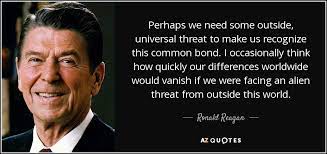
President Reagan, while addressing the United Nations in 1987, stated that he wished of an alien invasion in the hopes that it would unite people. But would it really given what we have seen? I do not think it would happen after the response to this crisis. Donald Rumsfeld stated it best: “Governments are good at two things, nothing and freaking out”. I do not think the government has let us down the past 20 months.
What should have been treated as a health emergency was treated as an economic emergency and has now created further economic and societal disasters of inflation, shrinkflation, labor shortages, supply chain constraints, 50% increases in fuel, unnecessary mandates, polarization of values, and a feeling of insecurity in the globe. Nice work! Try actual science next time instead of political science.
There has not been nor will there ever be a unifying objective and pragmatic voice that leads the world so my advice is to take care of those directly around you, continue to surround yourself with people that value freedom and rights, and do the best you can to navigate the policies and individuals that try remove those.
The plus side, I have found, is that there are still people that value work and want to add value to the world. I’m trying to find more of them and will help support the ones I already have found. By the way, none of them are elected or appointed by those elected in either party. It will be up to the private sector as usual to fix the messes caused by policies and perceptions.
Drive Your Own Car in Your Own Lane
Recently on American Idol, Phillip Phillips sang Stevie Wonder‘s “Superstition” to close out the first “American Idol” finals round.
Steven Tyler said, “you just are…Okay”…. Jennifer Lopez liked how he made the song his own and said “you killed it.” Randy Jackson liked his originality and liked how he interpreted somebody else’s song and told him “You drive your own car in your own lane!”
That hit a point with me about the entrepreneurial companies I work with on a weekly basis and how they have had success doing things their way but are not always fully understood.
When an entrepreneurial company wants to do something new, navigate into a new market, or develops a new way of doing things, they do not always get positive feedback from the direct “stakeholders” about what they envision or what they are trying to accomplish. Two reasons for this are 1) that they have not effectively communicated why they are trying to do something new, and 2) they do not have the right people in place to execute their vision.
Have a vision, set a goal, create a plan, communicate the plan to all parties involved, inform everyone of their role in the plan, live by example, and do what you say you are going to do. Once these things are in place, you can hold people accountable to their role in the plan and you will be driving your own car in your own lane and continuing your success.
I hope these thoughts and philosophies help you increase your opportunities.

 Peter C. Rathmann